
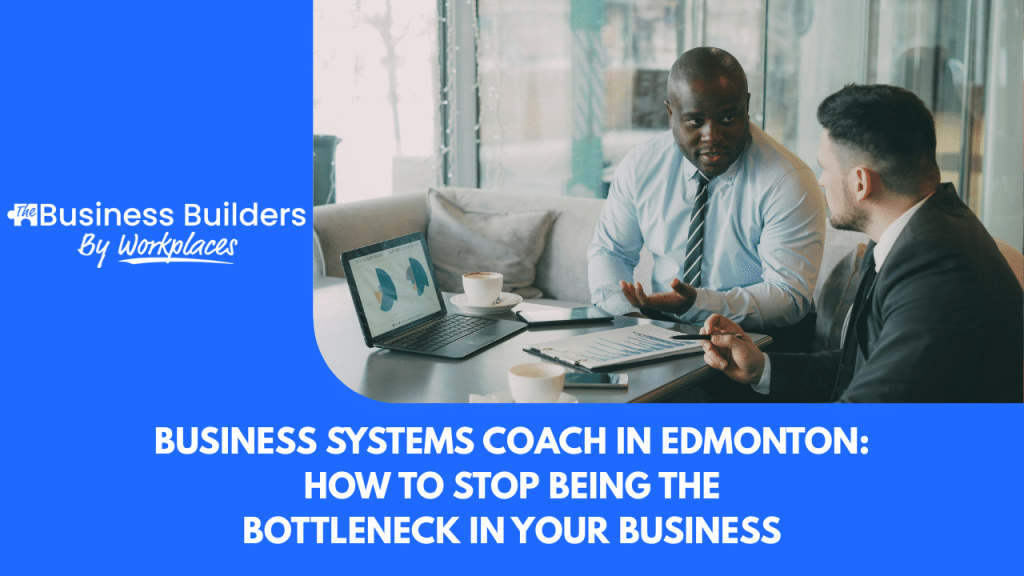
Business Systems Coach in Edmonton: How to Stop Being the Bottleneck in Your Business
You started your business for freedom. More control over your time. More income potential. More say in the kind of work you do and the kind of life you build. But somewhere along the way, the business started depending on you for everything. Every customer issue, staff question, quote, schedule change, cash flow problem, and decision seems to land back on your desk. That is exactly where a business systems coach in Edmonton can help.
The problem is not that you are lazy. It is usually the opposite.
Most small business owners become the bottleneck because they care too much, work too hard, and keep carrying things that should have been turned into systems a long time ago. What started as “I will just handle it myself” eventually becomes a business that cannot function without the owner constantly stepping in.
At The Business Builders by Workplaces, the focus is on helping business owners move through the real stages of business: Start Up, Scale Up, and Fix Up. Whether the issue is cash flow, operations, leadership, profitability, or team accountability, the goal is not more theory. The goal is to build a business that works better in the real world. You can explore their approach to practical business support through the The Business Builders business coaching and consulting services.
Why So Many Small Business Owners Become the Bottleneck
A bottleneck happens when too many decisions, approvals, tasks, and problems have to pass through one person before anything can move forward.
In a small business, that person is usually the owner.
This is especially common in trades, contracting, construction, field services, personal services, and owner-operated companies. The owner often starts as the best technician, salesperson, estimator, project manager, customer service rep, and problem solver in the business.
That works for a while.
Then the business grows.
More leads come in. More staff are hired. More jobs are booked. More customers need updates. More money moves through the company. More mistakes become expensive. Suddenly, the same habits that helped the business survive are now stopping it from growing.
Common signs you are the bottleneck include:
- Your team asks you the same questions repeatedly.
- Jobs are done differently depending on who is working.
- You cannot take a real vacation without the business slowing down.
- You are still involved in every quote, complaint, hire, and purchase.
- Cash flow feels reactive, even when sales are strong.
- You are constantly busy, but not always profitable.
- Growth creates more stress instead of more freedom.
The frustrating part is that many owners think this is just the price of being in business. It is not.
It is often a systems problem.
How a Business Systems Coach in Edmonton Helps Owners Get Unstuck
A coach helps owners identify where the business is overly dependent on them and then build better ways of operating. That can include processes, team roles, meeting rhythms, accountability structures, dashboards, delegation habits, and financial routines.
This is different from generic advice like “work on the business, not in the business.”
Most owners already know they should work on the business. The problem is that they are buried in urgent tasks and do not know where to start.
A systems-focused coach helps answer practical questions like:
- What should be documented first?
- Which tasks should the owner stop doing?
- Who owns each part of the workflow?
- Where are leads, jobs, money, or decisions getting stuck?
- What does the team need in order to take more responsibility?
- What needs to be measured every week?
- What process would reduce repeated mistakes?
The goal is not to make the business cold or corporate. The goal is to make the business clear.
A good system does not remove personality from a business. It removes confusion.
When expectations are clear, people perform better. When processes are repeatable, customers get a more consistent experience. When numbers are visible, decisions become easier. When roles are defined, the owner does not have to be the answer to every problem.
What Business Systems Actually Mean
A lot of owners hear the word “systems” and immediately think of software. CRMs, project management boards, accounting platforms, automation tools, dashboards, and spreadsheets can all be useful.
But software is not the system.
A system is the repeatable way your business handles an important activity.
For example, a lead intake system answers:
- Where do new leads go?
- Who responds?
- How quickly do they respond?
- What questions are asked?
- How is the lead tracked?
- What happens if the customer does not reply?
- When is the lead considered lost, active, or booked?
That system might use software, but the software is only one part of it.
Here are some core business systems most small companies need:
| Business Area | System Needed | Why It Matters |
| Sales | Lead tracking and follow-up | Stops opportunities from being forgotten |
| Operations | Job workflow | Keeps work consistent from start to finish |
| Finance | Cash flow routine | Helps protect profit, owner pay, and stability |
| People | Roles and responsibilities | Reduces confusion and repeated questions |
| Leadership | Meeting rhythm | Creates accountability and communication |
| Customer Experience | Communication standards | Builds trust and reduces complaints |
| Quality Control | Final checks | Prevents avoidable mistakes |
The mistake many owners make is trying to systemize everything at once. That usually creates overwhelm.
A better approach is to start where the pain is loudest.
If leads are being missed, start with sales follow-up. If jobs are chaotic, start with workflow. If staff keep asking the same questions, start with roles and responsibilities. If cash flow is unpredictable, start with financial routines.
Small improvements in the right places can create massive relief.
The Core Systems Every Small Business Owner Needs First
Not every business needs a complicated operations manual on day one. In fact, overcomplicating systems can be just as damaging as having none.
Most small businesses should start with a few practical systems that immediately reduce stress and improve consistency.
- Lead intake and follow-up
Every lead should have a place to go, a person responsible for it, and a follow-up process. Missed leads are expensive because the business already did the hard work of getting attention.
- Quoting and estimating
Quotes should be consistent, trackable, and based on clear standards. When quoting lives only in the owner’s head, pricing becomes inconsistent and hard to delegate.
- Job workflow
From booking to completion, the team should understand the steps. Who confirms the job? Who orders materials? Who updates the customer? Who checks the final work?
- Cash flow rhythm
Profit does not happen by accident. Owners need routines for reviewing money, expenses, receivables, payables, margins, and owner compensation. Mike Michalowicz makes the case well in his book Profit First: take the profit off the top rather than hoping for whatever survives to the bottom. The framework is his, and it reads well alongside whatever cash rhythm you decide to run.
- Role clarity
People perform better when they know what they own. A simple org chart, even in a small business, can reduce confusion quickly.
- Meeting cadence
A short weekly meeting can prevent dozens of interruptions. The point is not to have meetings for the sake of meetings. The point is to create a predictable rhythm for decisions, updates, and accountability.
These systems do not need to be perfect. They need to be used.
A simple system people follow is better than a beautiful document no one opens.
How Delegation Breaks Down Without Accountability
Many owners say, “I tried delegating, but it did not work.”
Usually, what they mean is that they handed something off once, it went badly, and they took it back.
That is not delegation. That is a failed handoff.
Real delegation requires structure. A team member needs to know:
- What outcome is expected
- What standard must be met
- When it is due
- What authority they have
- When to ask for help
- How success will be reviewed
Without those pieces, delegation becomes guesswork.
The owner gets frustrated because the task was not done “right.” The employee gets frustrated because “right” was never clearly explained. Then the owner takes the task back and the business becomes more dependent on them than before.
Accountability fixes this, but accountability is often misunderstood.
Accountability is not punishment. It is not yelling. It is not hovering. It is simply the practice of making expectations visible and following up consistently.
Strong accountability sounds like:
- “Here is the result we need.”
- “Here is what good looks like.”
- “Here is when we will check in.”
- “Here is what you own.”
- “Here is where I can support you.”
That kind of leadership gives people room to grow without leaving them alone in confusion.
Building a Business That Does Not Depend on Your Memory
One of the biggest problems in small business is that too much information lives in the owner’s head.
The owner knows which customer is picky. The owner knows which supplier is fastest. The owner knows how to price the weird jobs. The owner knows which employee needs extra detail. The owner knows what went wrong last time.
That knowledge is valuable, but if it stays trapped in the owner’s mind, the business stays fragile.
Getting the business out of your head may involve:
- Writing simple SOPs
- Creating checklists
- Building quote templates
- Defining job stages
- Setting customer communication standards
- Creating dashboards
- Using project management boards
- Clarifying roles
- Training team leads
- Reviewing numbers weekly
This is where coaching and consulting can work together. Coaching helps the owner shift behavior, decision-making, and leadership habits. Consulting helps create practical tools, documents, systems, and structures the business can actually use.
For many owners, that combination is powerful because they do not just need encouragement. They need implementation.
FAQ: Business Systems for Small Business Owners
What does a business systems coach do?
A business systems coach helps owners organize how the business runs. This can include workflows, delegation, accountability, cash flow routines, staff roles, customer communication, and leadership structure.
How do I know if I am the bottleneck in my business?
You are likely the bottleneck if your team cannot make decisions without you, the same questions keep coming up, customers rely on you personally, or the business slows down when you are away.
What systems should a small business build first?
Start with lead tracking, quoting, job workflow, cash flow review, role clarity, customer communication, and a simple weekly meeting rhythm.
Is a system the same as software?
No. Software can support a system, but the system is the repeatable process. A CRM is only helpful if your team knows how and when to use it.
Do trades and contractors really need business systems?
Yes. Trades and contractors often need systems because scheduling, quoting, materials, customer communication, staff coordination, and cash flow can become chaotic quickly.
Can systems help with profitability?
Yes. Better systems can reduce missed leads, pricing mistakes, rework, delays, poor communication, and cash flow surprises. All of those affect profitability.
How do I delegate without losing control?
Define the outcome, standard, deadline, owner, and check-in rhythm. Good delegation gives responsibility to the team while keeping accountability visible.
What is the difference between an SOP and a system?
An SOP is a written instruction for a task. A system includes the full structure around that task, including people, tools, timing, expectations, and follow-up.
How long does it take to build systems in a business?
It depends on the size and complexity of the business. Most owners should start with one high-impact area instead of trying to fix everything at once.
Why do business systems fail?
Systems fail when they are too complicated, not connected to real work, poorly explained, or not reinforced by leadership. Adoption matters more than documentation.
Stop Carrying the Whole Business Yourself
A business should not depend on the owner’s memory, energy, and constant availability forever. At some point, the work has to become repeatable. The team has to become more capable. The numbers have to become clearer. The owner has to stop being the only person holding the whole thing together.
That does not happen by accident. It happens when better systems, better delegation, and better accountability become part of how the business operates every week.
If your business is growing but your stress is growing with it, the next step may not be working harder. It may be building a company that can finally run with less daily pressure on you. That is exactly where a business systems coach in Edmonton can help you create momentum that lasts.
If any of this sounds like your week, book a conversation. Sixty minutes, no pitch, and you leave knowing whether we are a fit.
Where owners usually start
- Profit and cash flow, when the work is there but the money is not.
- Business process improvement, when everything still runs through you.
- Business productivity, when the days are full and the results are not.
- Team alignment and leadership, when the crew is capable but not pulling together.
Listen instead
- The execution trap, why a good plan still does not get done.
- Cash flow management, where the money actually goes.
- Mastering your start up, the first years without the guesswork.
The Business Builders by Workplaces
Ready to talk about your business?
Pick a time that suits you. No pitch and no pressure, and you leave knowing whether we are the right fit.
Book a conversation