
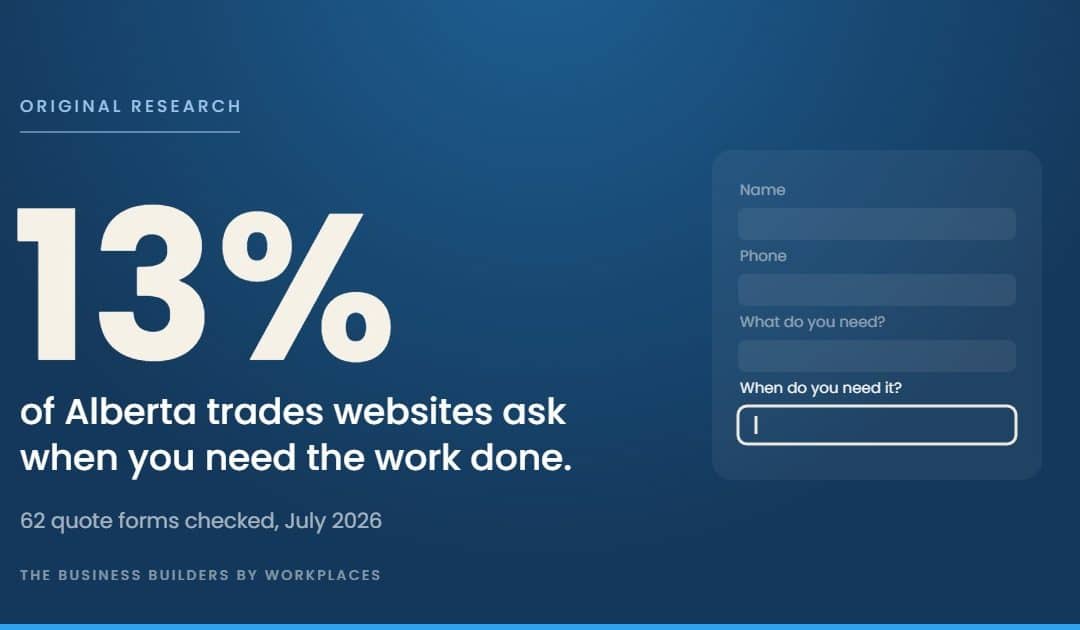
In July I looked at 62 Alberta trades and construction companies and asked one question of each of them: what actually happens when a customer with money in hand tries to buy something from you.
Not what happens on the phone. Not what happens once you are on site. What happens at the front door, on the web page, in the thirty seconds before a human being is involved at all.
I am Bruce Baker. I coach owners in construction and the trades through The Business Builders by Workplaces in Edmonton, and most of that work is about margin, people and cash. This one was different. I wanted a number rather than an opinion, so I went and counted.
What I did, stated up front
62 companies across plumbing, HVAC, electrical, roofing, concrete, and framing or general contracting, in the Edmonton and Calgary areas. Owner-operated, roughly 5 to 50 staff. Franchises, large commercial firms and directory sites were excluded.
Nobody was contacted. No form was submitted, no enquiry was sent, no company was named then and none is named now. Everything recorded is what any member of the public can see on a public web page.
Two things worth admitting because they change how much weight the numbers carry. The sample was found through search, which leans it toward firms that already invest in being findable. That makes every figure below a conservative ceiling, not a floor. And I collected 62 rather than stopping at a round 50, deliberately, so the sample could not be quietly trimmed once the results were visible.
The headline: only 13% ask when you need the work done
Eight companies out of the 61 with a working quote form ask about timing, urgency, or a date. The other 53 collect a request with no indication of whether it is an emergency or something the customer is thinking about for next spring.
Sit with that for a second. A burst pipe on a Friday night and a kitchen someone might do next year arrive in the same inbox, looking exactly the same.
Nobody can triage them. Nobody can schedule from them. Nobody can put a value on them. The only way to find out which is which is to phone and ask, which is a call somebody has to remember to make, on a day that is already full.
The fair objection here is that timing often comes out in the free-text box, or on the follow-up call. That is true, and I will concede it. The claim is not that you never find out. The claim is that you do not capture it in a form you can sort, route, and measure. Information trapped in a paragraph of free text is not a system. It is a hope.
The finding that surprised me more
52% of the forms ask for an address of some kind. That number looks like good news until you look at where it comes from.
Almost every one of those traces back to a platform default. Jobber’s work request form supplies street, city, province and postal code automatically. Squarespace’s address block does the same. The firms did not decide to ask. Their software asked for them.
Exactly one company in 62 deliberately separates the two, asking for a mailing address and then, separately, for the job address if it is different from the one above. One, out of sixty-two.
The front door is not being designed. It is being inherited.
That is worth saying out loud, because it cuts both ways. The companies that look organised at the front door mostly are not; they picked a platform and the platform picked for them. And the companies that look behind are usually one settings screen away from catching up. Nobody in this market has built a moat here. The whole thing is still open ground.
I should be careful with the address number too. A generic address field may well be a billing address rather than a job site, and since only one firm in 62 tells them apart, some of that 52% is ambiguous. The honest wording is that they ask for an address of some kind. Not that they ask where the job is.
One trade has already solved this
13 of 14 roofers ask for the address. Across every other trade it is 19 of 47.
Hail and insurance work makes the property the first question, so roofing built the habit because the money forced it to. Roofing is not the exception to a weak standard. It is the one trade where the standard is strong, and the rest of us can copy it without inventing anything.
What this actually costs you
Every unstructured enquiry is a small tax. Somebody reads it, guesses at the urgency, phones to find out, maybe reaches them and maybe does not, then writes the answer somewhere it can be lost. Multiply that by the number of enquiries you get in a week and you have a part-time job nobody was hired for.
Worse, it makes your pipeline unreadable. You cannot tell a busy month from a slow one until the invoices land, because nothing coming in the front door carries a date on it. Owners routinely tell me their lead flow is fine and their scheduling is chaos. Often those are the same problem, arriving in the same inbox, three fields short of being solved.
Your next step, and it takes about ten minutes
Open your own quote form as if you were a customer. Not the admin view. The public one. Then check three things.
- Does it ask when the work needs to happen? Not a free-text box. A field with options you could sort by, such as emergency, this week, this month, or planning ahead.
- Does it ask where the job is, as its own question, separate from where the bill goes?
- Could a person who is not you pick up that submission and know what to do with it, without phoning anybody?
If the answer to any of those is no, you have found something worth fixing this week, and the fix is a settings change rather than a project.
If you would rather answer those three questions and see your score against all 62, I built the count into a tool. It takes about two minutes: The Front Door Test.
That is the whole point of counting 62 of them. Not to hand anybody a scorecard, but to show that the bar in this market is on the floor, and that stepping over it costs an afternoon.
If you want help turning the front door into a system that feeds the rest of the business rather than a form that feeds your inbox, that is the work we do. Start at The Business Builders. Build what compounds.
Where owners usually start
- Profit and cash flow, when the work is there but the money is not.
- Business process improvement, when everything still runs through you.
- Business productivity, when the days are full and the results are not.
- Team alignment and leadership, when the crew is capable but not pulling together.
Listen instead
- The execution trap, why a good plan still does not get done.
- Cash flow management, where the money actually goes.
- Mastering your start up, the first years without the guesswork.
The Business Builders by Workplaces
Ready to talk about your business?
Pick a time that suits you. No pitch and no pressure, and you leave knowing whether we are the right fit.
Book a conversation